How Mindfulness and Meditation Can Dramatically Boost Your Self-Esteem
In the constant hum of modern life, our minds are often our busiest and most chaotic spaces. A relentless inner critic narrates our days, quick to point out flaws, second-guess decisions, and compare our journey to the curated perfection we see in others. This internal monologue, left unchecked, can become a powerful force that systematically erodes our self-esteem, leaving us feeling anxious, inadequate, and fundamentally unworthy. We often search for external solutions—a new job, a new relationship, a new achievement—hoping they will silence the doubt. But what if the most profound solution lies not in changing our circumstances, but in changing our relationship with our own mind? This is the promise of mindfulness and meditation. These ancient practices are not about escaping reality or forcing positivity; they are about training our awareness to find a place of calm, clarity, and self-acceptance. This guide will delve into the science and practice of how mindfulness can dramatically boost your self-esteem.

The Inner Critic: The Unseen Architect of Low Self-Esteem
Before we can build a stronger sense of self, we must first understand what’s undermining it. For most people, the primary culprit is a powerful, automatic pattern of negative self-talk. This inner critic is the voice that whispers you’re not smart enough, attractive enough, or successful enough.
This constant internal criticism is devastating for our self-esteem. Self-esteem, at its core, is our overall subjective sense of personal worth or value. When our thoughts are consistently negative, we are effectively practicing the belief that we are unworthy. This isn’t just a feeling; it’s a deeply ingrained mental habit. According to the American Psychological Association, these negative thought patterns, known as cognitive distortions, are a key factor in the development and maintenance of low self-esteem and related conditions like anxiety and depression. The battle for a healthy self-esteem is, therefore, largely a battle for control over our own attention and thoughts.
What is Mindfulness, Really? It’s Not About Emptying Your Mind
A common misconception is that mindfulness and meditation are about stopping your thoughts or achieving a state of blissful emptiness. This is an intimidating and unrealistic goal. Instead, as defined by Jon Kabat-Zinn, a pioneer of secular mindfulness in the West, mindfulness is simply "awareness that arises through paying attention, on purpose, in the present moment, non-judgmentally."
Let's break that down:
-
Paying attention on purpose: It’s an intentional act. You are choosing where to place your focus.
-
In the present moment: You are not lost in regrets about the past or anxieties about the future. You are here, now.
-
Non-judgmentally: This is the most crucial part for building self-esteem. You observe your thoughts, feelings, and sensations without labeling them as "good" or "bad." You simply notice them.
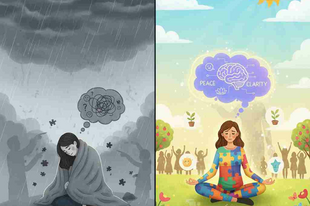
Think of your mind as the sky. Thoughts and emotions are like clouds, passing through. Mindfulness is the practice of resting as the sky itself, aware of the clouds but not defined by them. This creates a crucial space between you and your inner critic.
The Science of Stillness: How Meditation Rewires Your Brain for Self-Esteem
This isn’t just a philosophical concept; it's grounded in hard science. The practice of meditation physically changes the structure and function of your brain in ways that directly support a healthier sense of self.
Taming the Brain's Alarm System
Numerous neuroimaging studies, including landmark research from Harvard University, have shown that consistent meditation practice can lead to a decrease in the gray matter density of the amygdala. The amygdala is the brain's "fight or flight" center, responsible for processing fear and stress. A less reactive amygdala means you are less likely to be hijacked by anxious thoughts and self-criticism, which helps to stabilize your self-esteem.
Strengthening the CEO of Your Brain
The same studies show that meditation can increase the gray matter density in the prefrontal cortex. This area is associated with higher-order functions like awareness, concentration, and decision-making. A stronger prefrontal cortex gives you more power to regulate your emotions and consciously choose how to respond to your thoughts, rather than being a slave to them. This enhanced self-regulation is fundamental to a robust self-esteem.
This process of rewiring is known as neuroplasticity. Every time you practice mindfulness, you are literally carving new, healthier neural pathways in your brain. You are training your mind to be less critical and more compassionate by default.
From Critic to Observer: A Foundational Mindfulness Exercise
The first step in changing your relationship with your inner critic is to stop being fused with it. You are not your thoughts. Mindfulness teaches you to observe your thoughts from a distance.
Exercise 1: The "Name Your Stories" Technique
This is a simple but profound exercise you can do anytime, anywhere.
-
Notice the thought: The next time you feel a wave of self-doubt or hear your inner critic start its commentary, simply pause.
-
Label it: Mentally, or even out loud, label the thought pattern. For example: "Ah, there's the 'I'm not good enough' story," or "That's the 'I'm going to fail' story."
-
Don't engage: The key is not to argue with the story or try to push it away. Simply label it and let it be, like a cloud passing in the sky.
Why it works: By labeling your thoughts as "stories," you immediately create separation. You shift from being the main character in the drama to being the audience watching it. This simple shift in perspective breaks the automatic identification with the negative thought and dramatically reduces its emotional impact, giving your true self-esteem a chance to breathe.
Embracing Imperfection: Self-Compassion Through Meditation
Mindfulness, practiced over time, naturally leads to another crucial pillar of healthy self-esteem: self-compassion. This is the ability to treat yourself with the same kindness and understanding you would offer a good friend.
Dr. Kristin Neff, a leading researcher from the University of Texas at Austin, has identified self-compassion as one of the most powerful predictors of mental well-being. It’s a trainable skill, and meditation is one of the best ways to train it.
Exercise 2: The Loving-Kindness Meditation
This is a classic meditation practice designed to cultivate feelings of warmth and kindness toward yourself and others.
-
Find a comfortable posture: Sit in a chair or on a cushion with your back straight but not stiff. Close your eyes gently.
-
Start with yourself: Bring your attention to your heart area. Silently repeat the following phrases to yourself, letting the feeling behind the words sink in:
-
"May I be safe."
-
"May I be happy."
-
"May I be healthy."
-
"May I live with ease."
-
-
Extend to others (optional): You can then extend these wishes to a loved one, a neutral person, and even someone with whom you have difficulty.
Why it works: For those with low self-esteem, directing kindness inward can feel incredibly foreign and difficult at first. But with consistent practice, this meditation directly counteracts the habit of self-criticism. It teaches your brain a new way of relating to yourself—one based on care rather than judgment.
| Mindset Shift | From (Low Self-Esteem) | To (Mindful Self-Esteem) |
|
Relationship to Thoughts |
"I am my anxious thoughts." |
"I am aware of my anxious thoughts." |
|
Reaction to Mistakes |
Self-criticism and shame. |
Self-compassion and learning. |
|
Focus of Attention |
Stuck in past regrets or future worries. |
Grounded in the present moment. |
Practical Mindfulness for a Busy Life
You don't need to sit on a cushion for an hour a day to reap the benefits. Mindfulness can be integrated into your life in small, powerful moments.
Exercise 3: The 3-Minute Mindful Check-In
This can be done at your desk, in your car, or even in the bathroom.
-
Minute 1 (Awareness): Close your eyes and bring your attention to your inner experience. What are you thinking? What emotions are present? Just notice, without judgment.
-
Minute 2 (Gathering): Gently shift your focus to the physical sensation of your breath. Feel the air moving in and out of your body. This acts as an anchor to the present moment.
-
Minute 3 (Expanding): Expand your awareness to include your whole body. Notice the sensations of your feet on the floor, your hands in your lap, and the air on your skin.
Exercise 4: Mindful Walking
Turn a simple walk into a meditation. Pay full attention to the physical sensations of walking—the feeling of your feet hitting the ground, the movement of your legs, the air against your skin. When your mind wanders, gently bring it back to the sensation of walking.
Exercise 5: Mindful Listening
In your next conversation, practice truly listening. Instead of formulating your reply while the other person is speaking, give them your full, undivided attention. Notice their tone of voice, their body language. This not only improves your relationships but is also a powerful exercise in present-moment awareness.
Case Studies: Real-World Transformations
Case Study 1: The Imposter
Jane was a successful lawyer who lived with a crippling case of imposter syndrome. Despite her accomplishments, her low self-esteem convinced her she was a fraud. She started a daily 10-minute mindfulness meditation practice using an app like Headspace or Calm. "At first, my mind was just a chaotic mess of self-doubt," she recalls. "But I stuck with it. The biggest change was learning to see those thoughts as just... thoughts. Not facts. That separation gave me the space to actually see my own competence."
Case Study 2: The Socially Anxious Student
Tom, a university student, dreaded social events. His low self-esteem would manifest as intense anxiety and self-criticism. He began practicing the Loving-Kindness Meditation. "It felt so awkward to wish myself well," he says. "But after a few weeks, I noticed a subtle shift. I was just a little bit kinder to myself when I felt nervous. Instead of beating myself up, a part of me would say, 'It's okay to be anxious.' That small change made it possible for me to stay in situations longer and actually start connecting with people."
Frequently Asked Questions (FAQ)
I tried meditation and my mind was racing. Does that mean I'm bad at it?
Absolutely not. This is the most common misconception. The goal of meditation is not to have a blank mind; the goal is to notice that your mind has wandered and to gently, without judgment, bring it back. The act of returning your focus is the practice. There is no such thing as a "bad" meditation.
How long does it take to see a real difference in my self-esteem?
While you may feel calmer and more centered after just one session, building lasting, structural change in your self-esteem is a long-term project. With consistent practice (e.g., 10-15 minutes a day), most people report a noticeable positive shift in their mindset and emotional resilience within 4-8 weeks.
Do I need to sit in a specific posture or use special equipment?
No. You can practice mindfulness sitting in a chair, lying down, or even walking. The most important thing is to be in a position where you can be alert and comfortable. While apps and cushions can be helpful, the only essential equipment is your own mind and your willingness to pay attention.
Conclusion: Your Inner Sanctuary Awaits
The journey to building a healthy self-esteem is an inside job. While external achievements can provide temporary boosts, true, lasting self-worth is cultivated by changing your relationship with your own mind. Mindfulness and meditation are not about escaping from yourself; they are about coming home to yourself. They provide the tools to step out of the storm of your thoughts and find the quiet, clear sky within. By learning to observe your inner critic without being controlled by it, and by actively cultivating a voice of self-compassion, you can fundamentally change your brain and your life. Start today with one small exercise. Your most confident, peaceful, and authentic self is waiting.